Category: Uncategorized
Martie’s Success Story – NELGA Alumni
Martie Mushaukwa is a 2017 NELGA-DAAD Scholarship Alum with the Namibia University of Science and Technology. In his words, he shares his story on how NELGA’s support helped achieve his career goals.
I was born in the northeast part of Namibia in the Zambezi Region, in a small settlement known as Lusese, where I grew up with my brothers and sisters, raised by my father and stepmother. As a child, I only wished to be a better person which was supported by my father and his push for his kids to get a better education and succeed through hard work. At a young age, all I knew was to pass my classes, courses or exams. I could not understand how others failed class tests or homework that is until I got to high school, where my activeness in social life became more meaningful.
After completing high school, I was not sure what I wanted to study. I ended up enrolling for a degree in education at the University of Namibia. Within a short period of time, I realized that the career path I was about to take was not what I had imagined. I decided not to enrol in any field of study and devoted the whole year to getting better career guidance. The following year I settled for a career in real estate. This led to my enrollment for a Diploma in Land Valuation and Estate Management at The Polytechnic of Namibia (now transformed into Namibia University of Science and Technology, NUST). In 2013, I decided to further my studies by pursuing a Bachelor of Property Studies (Honours) at the same university. Upon graduation, I decided to further my studies in my field and In 2017, I was awarded a DAAD Scholarship through the NELGA programme to further my studies toward a Master of Spatial Science at NUST.
My experience with DAAD and NELGA was great. It enhanced my professional career, in the sense that after I obtained my master’s degree, I became more attractive as a job candidate and more knowledgeable in my field of specialization. I am thankful to the DAAD and NELGA for the scholarship as it has made my education and career goals easier to achieve. With this scholarship, I became a better researcher and analyst in my field of specialization. These endear me to my contemporaries in my field of work.
Since graduating, I have been working for an agricultural bank, where I am at the forefront of developing, implementing, and guiding the real estate valuation function within the organization, thus providing an overall framework for valuation approaches and practice. Hence, I have become one of the key leading professionals in the field of Real Estate, engaging in real estate matters and contributing to vital decision making at a high level.
Twenty-Two Students are the First to be Enrolled in the new NELGA Land Governance Masters at UGB
The course aims to address land governance peculiarities in the region for social development
In 2021, twenty-two students from across Africa made history as the first set of people to be enrolled in the new Master’s Degree program on Land Governance and Territorial Management at Gaston Berger University of Saint-Louis (UGB ) in Senegal. The Master’s program introduced with the help of NELGA provides a platform to develop adequate human and technical capacities to support the development and implementation of land policies in Africa. The students are subject to an interactive and interdisciplinary pedagogy regime with continuous personal follow-up of the Masters’ leaders.
Prof Ibrahim Diallo, Coordinator of NELGA Francophone West Africa and Professor of Public Law at UGB expressed his delight at the new academic program welcomed by the
academic and professional world at the sub-regional and continental levels. The course considers the region’s peculiarities and the AU endorsed Guidelines for the Development of Curricula on Land Governance in Africa, “West Africa’s diversity in terms of language, colonial history, political regimes and stages of economic development has resulted in pluralistic land tenure regimes. The Master’s program attempts to address such land governance issues in West Africa and offers vocational education, articulating theoretical and practical training in land governance and land management,” articulates Prof. Diallo.
The academic program provides NELGA-DAAD scholarships to the enrolled student. It ends with a mandatory internship that concretizes the orientation of the master towards professional practice with practical experiences on topics such as land systems, land legislation, domains, spatial planning, land market, land information systems, territorial cooperation and planning, environment and climate change, impact studies, land conflicts and others. The program prepares students for the employment market post-graduation as the internship facilitates the positioning and placement of young people in the public or private sector. “This academic program is an asset to the region and the continent as it integrates a review of the past and possibilities for the future by investing in the young people of today with key knowledge useful for the economic and social development of the continent,” explains Prof. Diallo.
Land Stakeholders in Senegal Plan to Address Parliamentarians on Land Reforms
Land governance stakeholders in Dakar will meet policymakers to discuss reforms needed in the land sector based on current trends in the country. The meeting on May 12 to 14, 2022, is convened by the Network of Excellence on Land Governance in Africa (NELGA), a Francophone West Africa node that Gaston Berger University hosts. It is a follow-up meeting to a sensitization workshop held in October 2020 and calls for land reforms that promote local governance and territorial development.
The 2020 workshop initiated a dialogue between policymakers and academics on the challenges of land governance and the revival of land reform in Senegal, especially in promoting local governance and territorial development through the creation of the High Council of Territorial Communities and the recognition of new rights to citizens. These new rights coincided with the recent expansion of the powers of the National Assembly to monitor government action and evaluate public policies. At the end of the 2020 workshop, critical land governance issues that concern parliamentarians were identified, including policy and legal actions to address climate change, large-scale agricultural investments, and land conflicts. Similarly, commitments were made by the Network of Parliamentarians for the Environment in Senegal (REPES) to advocate in parliament to revive land reform processes. The meeting designed a roadmap in respect of the commitments made at the workshop.
This 2022 sensitization meeting aims to follow up on the road map and commitments made by the parliamentarians, especially in the face of the emerging issues faced by the land space since 2020. Such as the amendments to Decree 72-12 88, the Orientation Law on Sustainable Development of Territories (LOADT), and an increase in the development of land projects in Senegal as these laws and processes impact citizens’ rights to property, resources and freedoms. The 2-day workshop will feature participants from NELGA-UGB academics, REPES members, HCCT members, local elected officials, civil society, the private sector and parliamentarians. The meeting is expected to conclude with the design of a new road map to identify the next series of actions towards land governance in Senegal.
Find the concept note below.
Central Africa Land Rights Webinar on Land Expropriation Held
French-speaking African countries are carrying out major development projects such as hydroelectric schemes, various communication and energy structures and other structures for their citizens’ benefit. To carry out these projects, many states need land. This is done through various mechanisms, including expropriation where necessary. However, these lands come at a price as states are sometimes forced to evict families living in the coveted areas.
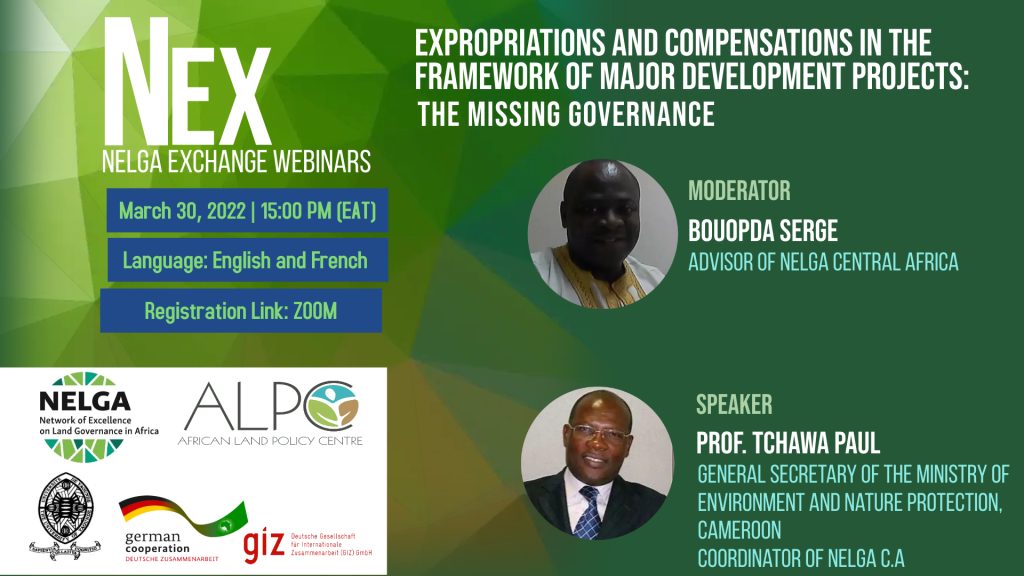
The Africa Land Policy Centre (ALPC), through NELGA, held a knowledge exchange Webinar on compensation mechanisms in Central Africa, especially Cameroon, on privately owned land taken by the government for the benefit of public use. The Webinar held on March 30, 2022, explored land expropriation and compensation mechanisms. The Webinar was hosted by NELGA Central Africa node with the support GIZ’s Strengthening Advisory Capacities for Land Governance in Africa (SLGA) program. It featured Prof Paul Tchawa, Commissioner Ministry of Environment and Nature Protection, Cameroon as its key speaker. Joan Kagwanja, Chief of ALPC, at the Webinar explained that the Central Africa region is a resource-rich investment area for Africa, especially in the regional integration of trade and investments. She emphasised the importance of exploring diverse large-scale land-based investment partnerships (LSLBI) before government expropriation, especially in line with the African Union principles and guidelines as endorsed by the AUC.
Prof Tchawa and the ensuing discussion called for participatory and applied solutions toward integrated development that leaves no one behind. They also called for stakeholders to learn from good practices as key to improving compensation processes, especially in humanising the process through resettlement plans while not compromising development objectives.
University of Yaoundé 1 Launch Review of its Curriculum on Land Tenure and Management
From April 12 – 15, under the chairmanship of Prof. Tchawa, Coordinator of the NELGA network on land governance for Central Africa, and with the financial support of NELGA through DAAD, the University of Yaounde 1 launched several review topics on land tenure for its existing Master’s program on Land Governance at the school. Content and courses reviewed include, cartography, information system and remote sensing applied to the sustainable management of territories.
Nearly 30 experts were gathered from across Cameroon. They discussed and shared their experience to update the curriculum of the Master programme which was originally established in 2009 and not reviewed since.
The review process applied the “Guidelines for the Development of Curricula on Land Governance in Africa” established by the African Land Policy Centre (ALPC). Through a preliminary analysis of the existing curriculum areas of improvement were identified, such as attention to the needs of marginalized groups, and preparing students to analyse conflicts related to land issues. The workshop produced a syllabus of the revised Master curriculum with descriptions of the modules, which will be used in the further progress to implement this updated curriculum.
Prof. Tchawa explained that it was timely and necessary to periodically review courses to ensure it aligns with current issues faced in the land space. He called on the participants to give their best in order to propose specialised content for the course on land management. The workshop documented the revised content for further review by management.
University of Yaoundé 1 Launch Review of its Curriculum on Land Tenure and Management
From April 12 – 15, under the chairmanship of Prof. Tchawa, Coordinator of the NELGA network on land governance for Central Africa, and with the financial support of NELGA through DAAD, the University of Yaounde 1 launched several review topics on land tenure for its existing Master’s program on Land Governance at the school. Content and courses reviewed include, cartography, information system and remote sensing applied to the sustainable management of territories.
Nearly 30 experts were gathered from across Cameroon. They discussed and shared their experience to update the curriculum of the Master programme which was originally established in 2009 and not reviewed since.
The review process applied the “Guidelines for the Development of Curricula on Land Governance in Africa†established by the African Land Policy Centre (ALPC). Through a preliminary analysis of the existing curriculum areas of improvement were identified, such as attention to the needs of marginalized groups, and preparing students to analyse conflicts related to land issues. The workshop produced a syllabus of the revised Master curriculum with descriptions of the modules, which will be used in the further progress to implement this updated curriculum.
Prof. Tchawa explained that it was timely and necessary to periodically review courses to ensure it aligns with current issues faced in the land space. He called on the participants to give their best in order to propose specialised content for the course on land management. The workshop documented the revised content for further review by management.
Échange de connaissances NELGA sur la gouvernance foncière en Afrique I Focus- Afrique centrale
NELGA Knowledge Exchange on Land Governance in Africa I Focus- Central Africa
Depuis quelques décennies déjà et ce, à la faveur de la pleine réalisation des objectifs de développement durable, des pays de l’Afrique francophone en général et le Cameroun en particulier se sont lancés dans la réalisation de grands projets (aménagements hydro-électriques, nouvelles villes, diverses infrastructures de communication et de transport d’énergie, etc.). Pour réaliser ces grands projets, les Etats ont besoin de terres. Pour les avoir, les Etats sont parfois obligés de procéder à l’éviction de familles qui occupent des espaces convoités ; ceci passe par divers mécanismes donnant lieu aux indemnisations et aux expropriations le cas échéant.
S’il est vrai que les expropriations pour cause d’utilité publique et les indemnisations qui y sont connexes obéissent à des règles préétablies, leur application n’est pas aussi simple car elles sont susceptibles de redessiner les cartes sociales, d’impacter durablement et parfois négativement des vies et être de ce fait une source de tension et de conflits. Au regard de la pratique qui a cours dans nos différents Etats, quel diagnostic est-il possible de faire de l’ensemble du processus d’expropriation et d’indemnisation ? Quelles solutions si elles étaient appliquées pourraient permettre de rendre ce processus plus crédible dans un contexte où le développement de nos pays demeure impératif ?
Le présent exposé qui sera fait par le Professeur TCHAWA Paul nous aidera à explorer la question de fond en comble et d’analyser ensemble :
- Les différentes facettes de cette réalité dans les pays de l’Afrique francophone avec ses causes et ses conséquences ;
- Les solutions appliquées/envisageables dans un contexte de véritable développement intégré qui prend en compte tous les aspects y compris sociaux ;
- Les bonnes pratiques susceptibles d’améliorer la gouvernance du processus d’expropriations et d’indemnisations en contexte de grands projets ;
- Les pistes à cours et à long termes permettant d’humaniser ce processus (notamment à travers l’identification de (i) meilleurs modèles pour la réinstallation des familles déguerpis et de (ii) réforme de textes) tout en ne compromettant pas les objectifs de développement.
Animé par le professeur Paul Tchawa avec le soutien de l’ALPC et de l’Université de Yaoundé 1, au Cameroun, le NEX fournit une plate-forme d’engagement pour discuter des défis auxquels sont confrontés les pays africains Français face à l’expropriation par l’état des terres sans possibilité d’indemnisation qui déclenche un conflit foncier. Le webinaire vise à identifier les bonnes pratiques et à discuter des solutions possibles pour le développement intégré parmi les parties prenantes et ainsi réduire ce genre d’appropriation.
Cliquez sur le lien ci-dessous pour vous inscrire à la webinaire
Lien: https://us06web.zoom.us/meeting/register/tZYqcu-gqjIiHNOKQzFI2x9OhPLxI5XPEzSF
Retrouvez ci-joint la note conceptuelle pour plus de détails.
Pour toute information ou demande de renseignements, veuillez contacter Bouopda Serge, serge.bouopda@giz.de ou Jennifer Aghaji, Jennifer.aghaji@un.org.
‘Access to Information is Mandatory under Ghana’s New Land Act’ States Paga Customary Land Secretariat, Ghana
The Coordinator of the Paga Customary Land Secretariat in Ghana, Madam Belinda Dantera, has specified that the 2020 Land Act of Ghana makes it mandatory to give out information to the public on requested land transactions. She was unaware that access to information applied to land transactions until she attended NELGA’s sensitization workshop on the 2022 Land Act held on February 2nd, 2022. The NELGA workshop organized by Kwame Nkrumah University of Science and Technology with funding from the German Development Cooperation through the Strengthening Advisory Capacities for Land Governance in Africa (SLGA) programme brought together traditional authorities, coordinators and representatives of selected Customary Land Secretariats on a sensitization workshop on Ghana’s New Land Act (Act 1036) of 2020.
At the workshop, Prof. John Bugri, NELGA’s Project Coordinator for anglophone West Africa, called for a land governance system whereby everybody in the land governance space operates in a transparent and accountable manner to the benefit of the people they serve. This was mainly in reference to Article 267 of the 1992 Constitution and in consideration of the new law, which adds a new criminal dynamic for defaulters to its provisions. Prof. Bugri urged coordinators of Customary Land Secretariats to keep quarterly records of land transactions in their jurisdictions and make these records accessible to their subjects to ensure accountability and transparency in land governance.
Speaking at the workshop, Dr. Elias Kuusaana of Simon Diedong Dombo University of Business and Integrated Development Studies emphasized that the 1992 constitution prescribes the framework for compulsory acquisition in Ghana. Still, the National land policy of 1999 requires that compulsory land acquisition is conducted with utmost circumspection. Amidst the persisting challenges, the Land Act 2020 (Act 1036) has come to deal with mandatory acquisition and compensation problems.
The workshop created the much-needed awareness and education on the new land governance regime in the country and improved upon implementing the new land legislation. The participants were encouraged to step down the knowledge gained from the training to their colleagues. This will ensure improved land governance in the country that stands the chance of minimizing land disputes and litigations. Participants were drawn from the Northern, Northeast, Savannah, Upper East and Upper West Regions of Ghana.
To read the full report, click here.
Background
A major factor in achieving socio-economic development is a substantial land governance system that can deliver secured land rights to all segments of society. Unfortunately, having secured land rights is not the experience for many land rights holders in developing countries. In Ghana, many land rights holders and land users experience challenges accessing land. In cases where access is secured, protecting rights to the land remains a challenge. Ghana operates a dual land tenure system. There are the state system and the customary system. The state system administers about 20% of the total land in Ghana, while the customary system, managed by several traditional leaders, administers the remaining 80%. This land tenure arrangement is spelt out in different land legislation, indicating that land users in Ghana could acquire land from either the state or traditional leaders. While traditional leaders have their mandate in land administration defined both in law and custom, their role is limited to granting various rights and interests in the land they oversee. Traditional Leaders do not have the mandate to determine and approve land uses, nor do they manage the registration of rights and interest in land. Those functions are reserved for state agencies to perform. This means that one can negotiate and conclude an agreement for a parcel of land with a traditional leader. However, the state can only grant approval for the type of use and registration of the land. The interlinkages between the functions of the state and those of traditional leaders make it necessary to coordinate land administration services between the two systems. Such coordination would build a stronger land tenure system that delivers secured land rights. Unfortunately, there is limited coordination between the state and the customary land tenure system, resulting in many challenges and threats to land tenure security. The passing of the new Land Act, 2020, ACT 1036, is considered by many, as an opportunity to address the challenges in the land sector in Ghana. This is because the new legislation is believed to contain provisions that address many of the contemporary issues in the land sector and; attempt to establish the needed coordination between the state and the customary systems in promoting sound land governance practices. The passing of the new legislation is indeed a significant milestone in Ghana’s history of land governance. However, having good legislation alone is not enough.


Nancy’s Success Story – NELGA ALUMNI
Nancy Kankam is a 2017 NELGA-DAAD scholarship holder at Kwame Nkrumah University of Science and Technology (KNUST). She shares her story on how NELGA support amplified her career goals
“Growing up with four sisters, I had a strong desire to be great in the future”, Nancy recalls, though she wasn’t sure what that entailed. However, she did know that education was the way to greatness, so she took it very seriously. Fortunately, her family also valued education and provided her with the best opportunities possible from elementary to secondary school.
After completing high school, Nancy was unsure what career path she wanted to take. The only thing she was certain of was her aptitude for numbers, which made her want to pursue a degree in business management. However, she had no idea that a watershed moment was on the horizon when she was admitted to Kwame Nkrumah University of Science and Technology’s (KNUST) Department of Planning to pursue a Bachelors of Science (BSc) in Human Settlement Planning. In her first semester of study, Nancy had a moment of regret for taking up the course. This changed during her second semester when she found herself thriving and enjoying her academic programme, especially as the programme exposed her to the design and application of solutions to society’s wicked problems.
After her graduation in 2016, she was awarded a DAAD scholarship through the NELGA programme to further her studies towards an MPhil Planning academic program at KNUST in 2017. She said, “My experience with DAAD and NELGA was fantastic, with ceaseless imprints in my professional life. I had the opportunity to attend the Land Governance Conference in Addis Ababa, Ethiopia, and to conduct research for five months at the Technical University of Munich (TUM) in Munich, Germany. The research with TUM on “discourse on Women and Land Tenure in Ghana: Does a Matrilineal Land Tenure System Make a Difference for Women?” 11was recently published as a book chapter in Land Governance and Gender publication. Thanks to the DAAD – NELGA scholarship, I broadened my network and improved my knowledge and skills, particularly in research. “
As she relishes her experience, she also shares how this opportunity has impacted her career, “My bachelor’s degree in Human Settlement Planning, followed by a master’s degree in MPhil planning, formed the basis of my career in the development sector. They provided the foundation for me to conceptualize, design, initiate, implement, and share knowledge, actions, and policy recommendations for sustainable development in West Africa and Africa as a whole. Particularly, the opportunity provided by the DAAD – NELGA scholarship exposed me to topical global and regional issues in the development field and seasoned practitioners and researchers in the field. These experiences have shaped my perspectives and practice.”
Since graduating, Nancy has been working in the non-profit sector. She is keen on promoting research-policy linkages towards solving development problems. She applied lessons from the NELGA-DAAD program in the real-time post-graduation settings. In January 2022, she organized a brainstorm session among land stakeholders and DAAD alumni in Ghana to connect and communicate research to practice through a grant she had applied and secured through DAAD. Nancy hopes to continue working in the development trajectory and be an influencer for a safe, inclusive, and sustainable society.
Land Professionals in Africa To Publish Land Governance Experts Profile Reference Guide
At an extraordinary experts group meeting (EGM) held from February 14 to 17, 2022, in Rabat, Morocco, land governance experts in Africa agreed to publish a book that describes and defines the profile of the Land Governance Expert in Africa. The guide helps identify experts and their needs and strengthens their capacity to meet land governance challenges on the continent.
The meeting was convened by the Institut Agronomique et Veterinaire Hassan II (IAV II) Morocco with support from AU -UNECA- AfDB African Land Policy Center (ALPC), under the Network of Excellence in Land Governance in Africa (NELGA) programme for North Africa. The EGM, under the theme, Professional Land Actors and Their Contributions To Economic And Social Development, brought together land professionals who highlighted their contributions and other needs towards creating resilient land governance for emerging economies. The EGM grounded their discussion using several Africa Union (AU ) endorsed guidelines. The experts called for the introduction and use of an African Land Tenure Career Reference System (ALTRS) to feature land experts profiles and roles in land governance in Africa.
ALPC Coordinator, Dr Joan Kagwanja, commended IAV for convening this large body of experts as a convergence point to reflect on the profile of land experts in Africa and to build capacity gaps of these land experts in providing technical assistance and support to their respective AU Member States. ALPC has developed several AU endorsed guidelines on what the land industry needs towards economic development. Land experts need to support introducing and using these guidelines through policies and frameworks to ensure responsible land governance in their regions.
Prof. Abdelaziz El Hraiki, Director IAV Hassan II, lauded the meeting theme and explained that the current land tenure systems in the region do not guarantee sustainable land governance. He called on national governments to bring in qualified experts, introduce academic structures to support governance processes and come up with solutions based on the needs of the region and constraints of the multiplicity of the land tenure system.
The meeting allowed various professionals such as surveyors, urbanistic and architects, notaries and land lawyers, chartered experts, sociologists and anthropologists, etc., to share their views about priorities in their land sectors, country and sectorial orientations, and recommendations of the land governance. A diagnosis of land governance expertise was discussed in order to establish the land expert profile guide. The expertise reference guide will be shared in future for validation and endorsement.
Click below to read:
Reports from the Expert Meeting on February 14 and February 17, 2022