Understanding FAO’s Land Tenure and Governance Report: 7 Insights and 3 Actions
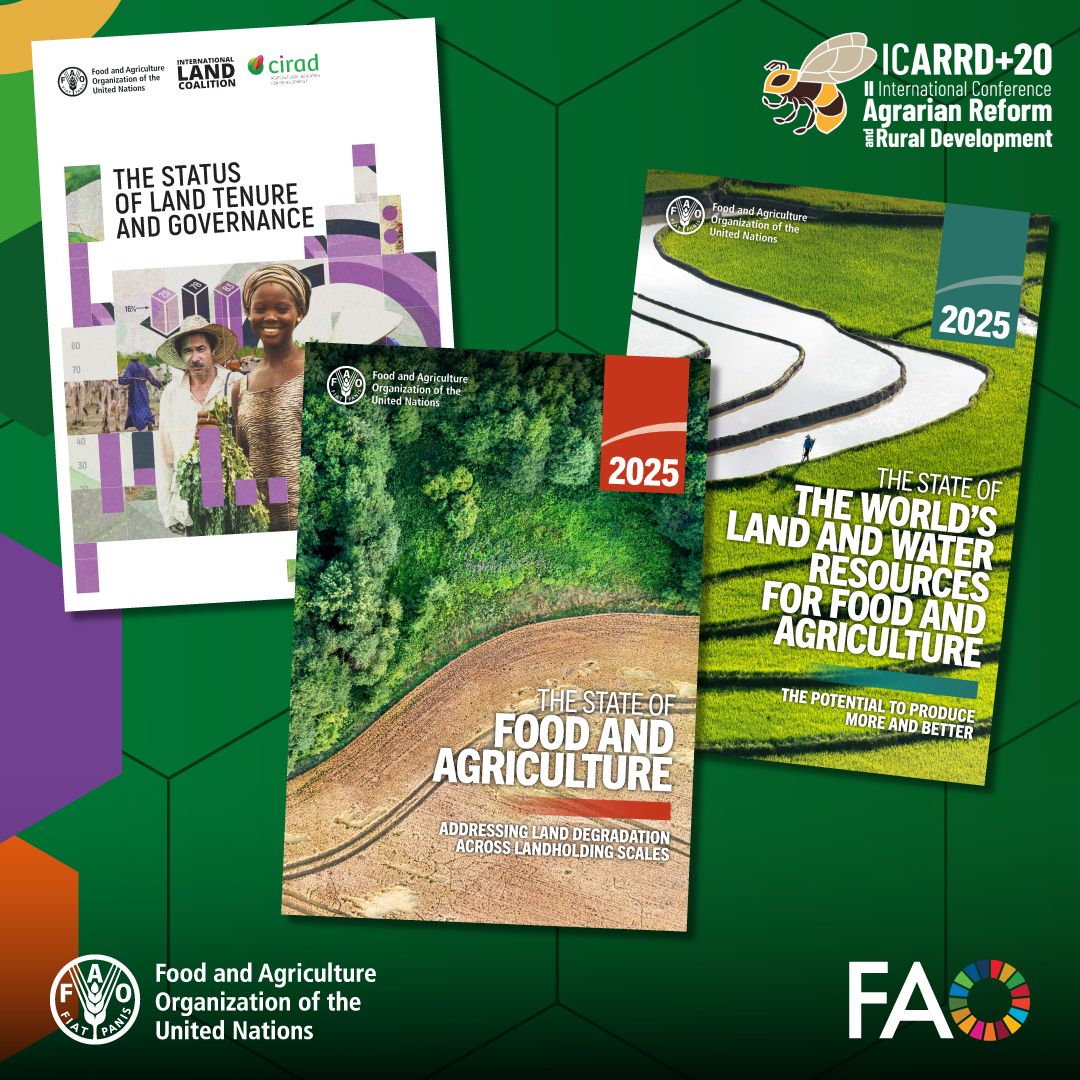
The recently launched FAO Status of Land Tenure and Governance report confirms a stark reality: the world faces a profound land inequality problem. Highlighted at the second International Conference on Agricultural Reform and Rural Development (ICARRD+20), the report provides compelling evidence that land redistribution must be central to addressing intertwined crises of poverty, hunger, and ecological degradation.
Land inequality has wide-ranging impacts: it exacerbates poverty, threatens food security, undermines social cohesion, stifles economic growth, fuels conflict, weakens democratic governance, and drives environmental degradation. Sub-Saharan Africa and South Asia, while relatively less unequal, face rising pressures from population growth, industrial agriculture, extractive industries, and urbanisation — a “land squeeze” that increasingly threatens livelihoods.
The report also reveals critical gaps: laws and policies on women’s land rights are insufficiently implemented; formalisation does not always enhance tenure security; and data collection remains inadequate, making it difficult to monitor progress effectively. Between 2019 and 2023, the percentage of people who perceive their land rights as insecure rose from 19% to 23%, highlighting the urgency of action.
What is needed is not more guidelines, but decisive implementation. ICARRD+20 proposes three urgent steps: first, publicly affirm that land inequality is detrimental to human rights, development, democracy, and the environment; second, place land redistribution at the centre of governance and rural transformation initiatives; and third, establish mechanisms for tracking outcomes, including land Gini coefficients, to monitor progress in reducing inequality and improving tenure security.
FAO’s report provides the mirror the world needs. Now, governments, civil society, and research institutions must act to turn evidence into transformative change.