Rangelands, Rights, and Restoration: Land Governance at the Heart of Combating Desertification and Drought
Reflections on World Day to Combat Desertification and Drought – 17 June 2026
Desertification and drought are not purely climatic phenomena. This year we use the World Day to Combat Desertification and Drought to look at what the research reinforces: that how land is governed, who holds the rights over it, who can use it and on what terms, and what policies regulate its management determines if dryland communities can adapt, restore and thrive.
Combating desertification and drought is, at its core,
a question of land governance.
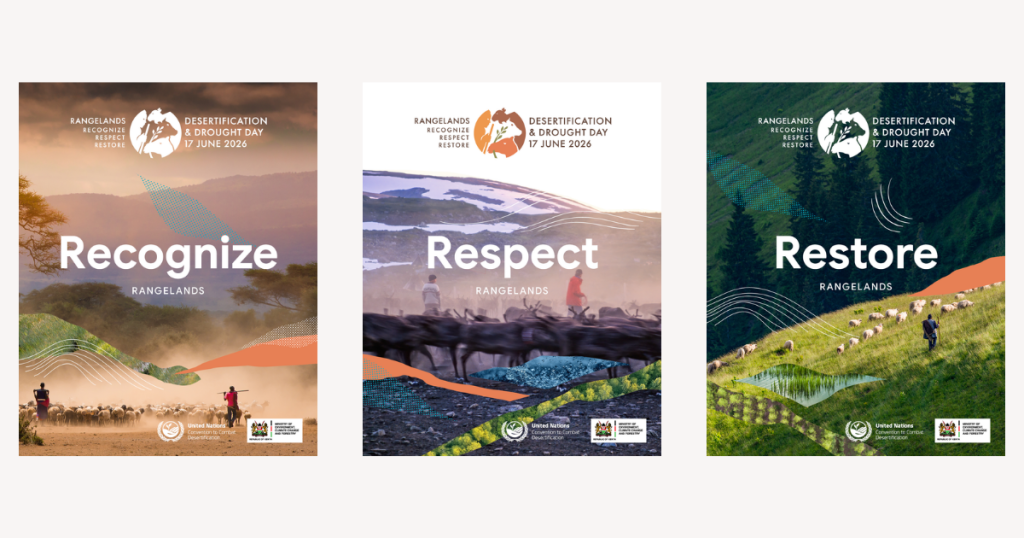
The World Day to Combat Desertification and Drought was established by the UN General Assembly in 1994 and this year it falls within the International Year of Rangeland and Pastoralists (IYRP 2026). The 2026 theme, “Rangelands: Recognize. Respect. Restore.” calls for the recognition of the economic, ecological and cultural value of rangelands, respect for their traditional stewards, and stronger investment in restoring degraded landscapes for generations to come.
The global observance on June 17th is hosted by Kenya, where rangelands cover 80% of the country and sustain millions of people largely through pastoralism and livestock. This global observance highlights the central role of the world’s rangelands in climate resilience, food and water security, biodiversity conservation, and the cultural identity of pastoralist and Indigenous communities
Land governance is the missing link that can determine
whether dryland ecosystems degrade or remain resilient.
The IPCC Special Report on Climate Change and Land (SRCCL) is clear on this point. Sustainable land management practices in drylands can increase agricultural productivity and contribute to both climate adaptation and mitigation but only when the enabling governance environment exists to support them. When there are gaps in governance such as weak tenure, absent early warning systems and a lack of community participation, it becomes clear that climate change amplifies governance failures.
For practitioners, researchers, policymakers, and advocates grappling with desertification and drought in Africa, the NELGA Network offers a uniquely interdisciplinary resource. Our network of researchers and institutions across Africa is a resource for evidence, exchange, and the kind of interdisciplinary thinking that this crisis demands.
When we speak of desertification, we tend to speak of rainfall deficits, rising temperatures, and overgrazing. These are real. But the evidence is equally clear that land tenure insecurity can drive degradation. Communities that lack secure rights over the land they depend on, have little incentive, and often little ability, to invest in its long-term health.
Research from East Africa shows that land demarcation by investors and state-driven titling programmes have, in many cases, increased tenure insecurity for pastoral communities and fuelled conflict over resources, thereby accelerating the very degradation they were meant to prevent (Robinson & Flintan, 2022, Pastoralism: Research, Policy and Practice).
Rangelands cover more than half of the Earth’s land surface. They span grasslands, savannahs, shrublands, deserts, wetlands, and mountain areas. These landscapes are often dismissed as “empty” or “unproductive,” but sustain over 500 million people whose livelihoods depend on pastoralism. They hold a third of Earth’s terrestrial carbon, support extraordinary biodiversity, and regulate water cycles critical to food production far beyond their boundaries.
Yet the UNCCD itself acknowledges that pastoralism is routinely misclassified alongside intensive livestock farming, leading to policies that actively undermine it. The most fundamental requirement of pastoral systems, that of mobility, is treated by many land tenure and water resource laws as either illegal or irrelevant, forcing pastoralists into sedentary systems that rapidly degrade the rangelands those laws were meant to protect.
Land Degradation Neutrality (LDN) is the UNCCD’s central framework, committing countries to avoid, reduce, and reverse land degradation, achieving a net neutral balance of healthy land by 2030.
The December 2024 UNCCD COP16 Decision on Rangelands and Pastoralists moved the needle further still, urging parties to prioritise policies and investments for sustainable rangeland management, emphasising responsible and inclusive governance, improved tenure security, and community engagement.
With more than 70 partner institutions across Africa, NELGA occupies a unique position. The crisis of desertification and drought in Africa’s drylands is also, at its deepest level, a crisis of governance knowledge and capacity.
The evidence base is growing. Papers like “The Nexus Between Land Tenure, Equity, and Climate Resilience Among Disproportionately Affected Populations in Southern Africa” in the African Journal on Land Policy and Geospatial Sciences are building the African-grounded empirical foundation for governance reform. Work by CIFOR-ICRAF connecting UNCCD implementation to tenure insecurity in East Africa provides the institutional analysis. NELGA’s own Climate Change and Land Governance in Africa course interrogates whether climate change policies can promote more equitable impacts for pastoralists, women, youth and others and further; what governance reforms would make that possible.
The upcoming UNCCD COP17 in Mongolia in August is an advocacy window. NELGA institutions can contribute research, engage with the formal negotiations on rangelands governance, and ensure that the African experience – where two-thirds of the continent is dryland and the stakes are highest – is visible and voiced when decisions are taken.
This year presents an opportunity for walking the path towards lasting resilience. The convergence of IYRP 2026, the June 17 World Day theme, and UNCCD COP17 in August creates a once-in-a-decade moment to:
- > recognize the value that rangelands, including drylands, and pastoralist communities already provide;
- > respect the rights, knowledge, and governance systems of pastoralists, Indigenous peoples and local communities; and
- > restore rangelands through sustainable and rights-based approaches that strengthen the resilience of communities.