Tag: africa
Rangelands, Rights, and Restoration: Land Governance at the Heart of Combating Desertification and Drought
Reflections on World Day to Combat Desertification and Drought – 17 June 2026
Desertification and drought are not purely climatic phenomena. This year we use the World Day to Combat Desertification and Drought to look at what the research reinforces: that how land is governed, who holds the rights over it, who can use it and on what terms, and what policies regulate its management determines if dryland communities can adapt, restore and thrive.
Combating desertification and drought is, at its core,
a question of land governance.
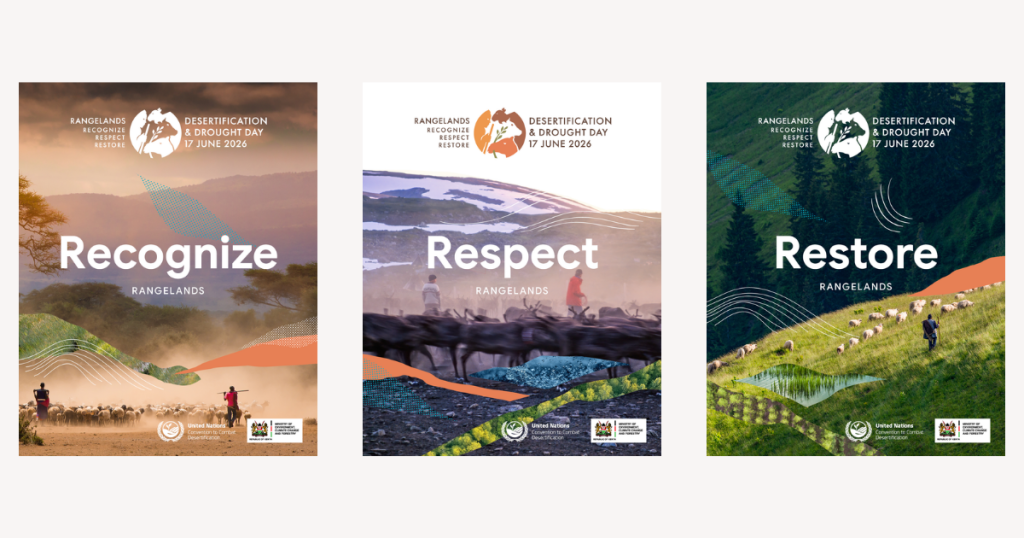
The World Day to Combat Desertification and Drought was established by the UN General Assembly in 1994 and this year it falls within the International Year of Rangeland and Pastoralists (IYRP 2026). The 2026 theme, “Rangelands: Recognize. Respect. Restore.” calls for the recognition of the economic, ecological and cultural value of rangelands, respect for their traditional stewards, and stronger investment in restoring degraded landscapes for generations to come.
The global observance on June 17th is hosted by Kenya, where rangelands cover 80% of the country and sustain millions of people largely through pastoralism and livestock. This global observance highlights the central role of the world’s rangelands in climate resilience, food and water security, biodiversity conservation, and the cultural identity of pastoralist and Indigenous communities
Land governance is the missing link that can determine
whether dryland ecosystems degrade or remain resilient.
The IPCC Special Report on Climate Change and Land (SRCCL) is clear on this point. Sustainable land management practices in drylands can increase agricultural productivity and contribute to both climate adaptation and mitigation but only when the enabling governance environment exists to support them. When there are gaps in governance such as weak tenure, absent early warning systems and a lack of community participation, it becomes clear that climate change amplifies governance failures.
For practitioners, researchers, policymakers, and advocates grappling with desertification and drought in Africa, the NELGA Network offers a uniquely interdisciplinary resource. Our network of researchers and institutions across Africa is a resource for evidence, exchange, and the kind of interdisciplinary thinking that this crisis demands.
When we speak of desertification, we tend to speak of rainfall deficits, rising temperatures, and overgrazing. These are real. But the evidence is equally clear that land tenure insecurity can drive degradation. Communities that lack secure rights over the land they depend on, have little incentive, and often little ability, to invest in its long-term health.
Research from East Africa shows that land demarcation by investors and state-driven titling programmes have, in many cases, increased tenure insecurity for pastoral communities and fuelled conflict over resources, thereby accelerating the very degradation they were meant to prevent (Robinson & Flintan, 2022, Pastoralism: Research, Policy and Practice).
Rangelands cover more than half of the Earth’s land surface. They span grasslands, savannahs, shrublands, deserts, wetlands, and mountain areas. These landscapes are often dismissed as “empty” or “unproductive,” but sustain over 500 million people whose livelihoods depend on pastoralism. They hold a third of Earth’s terrestrial carbon, support extraordinary biodiversity, and regulate water cycles critical to food production far beyond their boundaries.
Yet the UNCCD itself acknowledges that pastoralism is routinely misclassified alongside intensive livestock farming, leading to policies that actively undermine it. The most fundamental requirement of pastoral systems, that of mobility, is treated by many land tenure and water resource laws as either illegal or irrelevant, forcing pastoralists into sedentary systems that rapidly degrade the rangelands those laws were meant to protect.
Land Degradation Neutrality (LDN) is the UNCCD’s central framework, committing countries to avoid, reduce, and reverse land degradation, achieving a net neutral balance of healthy land by 2030.
The December 2024 UNCCD COP16 Decision on Rangelands and Pastoralists moved the needle further still, urging parties to prioritise policies and investments for sustainable rangeland management, emphasising responsible and inclusive governance, improved tenure security, and community engagement.
With more than 70 partner institutions across Africa, NELGA occupies a unique position. The crisis of desertification and drought in Africa’s drylands is also, at its deepest level, a crisis of governance knowledge and capacity.
The evidence base is growing. Papers like “The Nexus Between Land Tenure, Equity, and Climate Resilience Among Disproportionately Affected Populations in Southern Africa” in the African Journal on Land Policy and Geospatial Sciences are building the African-grounded empirical foundation for governance reform. Work by CIFOR-ICRAF connecting UNCCD implementation to tenure insecurity in East Africa provides the institutional analysis. NELGA’s own Climate Change and Land Governance in Africa course interrogates whether climate change policies can promote more equitable impacts for pastoralists, women, youth and others and further; what governance reforms would make that possible.
The upcoming UNCCD COP17 in Mongolia in August is an advocacy window. NELGA institutions can contribute research, engage with the formal negotiations on rangelands governance, and ensure that the African experience – where two-thirds of the continent is dryland and the stakes are highest – is visible and voiced when decisions are taken.
This year presents an opportunity for walking the path towards lasting resilience. The convergence of IYRP 2026, the June 17 World Day theme, and UNCCD COP17 in August creates a once-in-a-decade moment to:
- > recognize the value that rangelands, including drylands, and pastoralist communities already provide;
- > respect the rights, knowledge, and governance systems of pastoralists, Indigenous peoples and local communities; and
- > restore rangelands through sustainable and rights-based approaches that strengthen the resilience of communities.
Join NELGA’s Knowledge Session at CLPA23: The Role of Academic Institutions in African Land Governance
NELGA invites you to a captivating knowledge exchange and sharing session at the CLPA23. Taking place on Wednesday, November 22, from 11:15 am to 12:45 pm, the session will delve into the crucial role of academic institutions in shaping land governance across Africa.
Background: NELGA, a consortium of esteemed African universities and institutions, is committed to enhancing both institutional and human capacities to address the challenges affecting land governance in Africa. Responding to the ‘Declaration on Land Issues and Challenges in Africa’ by African Heads of State, NELGA has actively engaged in building capacities through training, research, curriculum development, and various initiatives aimed at fostering open access knowledge sharing.
This CLPA23 side event aims to explore the pivotal role of academia in advancing capacities for land governance in Africa. It also seeks to showcase NELGA’s accomplishments, providing a platform for the exchange of experiences and knowledge between academia, professionals, and stakeholders. The session is designed to attract new partners by highlighting NELGA’s achievements and contributions to land governance.
Agenda: Chaired by Prof. Ruth Hall, the session will feature a moderated panel discussion with distinguished speakers:
- Prof. Herbert Robinson: General remarks on the role of academic institutions in land governance in Africa.
- Dr. Agnes Mwasumbi: An overview of NELGA, its objectives, and benefits to member universities.
- Prof. John Bugri: Insights into how NELGA universities support land governance curricula and training opportunities.
- Prof. Eugene Chigbu: Discussion on NELGA’s research focus and its impact on policy processes in land governance.
- Prof. Moha-El Ayachi: Exploring NELGA’s sustainability, partnerships, and avenues for new collaborators.
Don’t miss this opportunity to engage in a dynamic discussion on the role of academia in shaping the future of land governance in Africa. Join us at CLPA23 on November 22 from 11:15 am to 12:45 pm and be a part of the conversation. Together, let’s build capacities for sustainable land governance in Africa.
NELGA’s Role in Advancing Community Land Rights at the Fourth Regional Conference
The Fourth Regional Conference on Securing Community Land Rights in Africa, held in Arusha, Tanzania from September 12-14, 2023, brought together delegates from across the continent to address the critical issue of community land rights.
Delegates at the conference emphasized the importance of implementing community titling processes as a means of protecting rural lands from encroachment and conflict. They recognized that the roles of National Land Institutions vary from country to country. For instance, Ethiopia’s ministry primarily focuses on resolving rural land tenure insecurity through land registration to mitigate conflicts, while Liberia’s Land Authority serves as a central hub for land administration and law enforcement to prevent overlapping functions among ministries.
The conference also candidly discussed common obstacles to effective implementation of the AU agenda on land, including institutional capacity limitations, challenges in educating communities about land policies, and inadequate funding for infrastructure and documentation. Key recommendations included improving land information systems, educating rural communities about land registration, monitoring data trends, and conducting research on land rights.
Dr. Dominico Kilemo, a NELGA advisor for Eastern Africa, highlighted two crucial aspects in line with NELGA’s mission. He advocated for closer collaboration between National Land Institutions and universities to inform decisions and policies regarding community land rights. Additionally, he proposed the organization of national stakeholder forums by National Land Institutions to facilitate robust policy dialogues on this issue.
The conference saw participation from influential development partners like the United Nations Economic Commission for Africa (UNECA), the African Development Bank (AfDB), the Food and Agriculture Organization (FAO), GIZ, and the Tenure Facility. These organizations engaged directly with land institution representatives, addressing concerns, and providing support for community land rights implementation.
In summary, the Fourth Regional Conference served as a dynamic platform for insightful discussions, knowledge sharing, and recommendations. These efforts collectively contribute to the pursuit of secure community land rights in Africa, underscoring the importance of collaboration and data-driven decision-making in regional land governance.
Registration open! The State of Land Data: Transforming Africa into a Powerhouse of the Future
Date & Time: Jun 22, 2023, 03:00 PM EAT
Discover how effective land data governance can transform Africa into a powerhouse of the future! We invite you to join our engaging webinar, co-organized by GIZ, BMZ, and NELGA.
This webinar aims to empower researchers and practitioners across Africa by enhancing their understanding of sustainable approaches to land data governance. By showcasing the significance of robust land data governance, we will explore its potential to improve property rights and streamline government services.
Attendees will gain valuable insights into how enhanced data governance can foster ethical and transparent land-related activities for individuals, communities, businesses, and government agencies. The webinar will also present real-world examples of SOLI research conducted in Southern African countries through a collaborative effort between the Land Portal Foundation and NELGA researchers.
Language: English (Simultaneous interpretation available in French, Portuguese, and Spanish)
Don’t miss this opportunity to be a part of the journey towards unlocking Africa’s potential through effective land data management. Register Here.
Unleashing the Power of Knowledge: NELGA North Africa Network to Host International Forum in Rabat
The NELGA North Africa Node is set to host its first International Forum of Knowledge (IKF2023), titled “Sharing knowledge and expertise in the domain of land policy and geospatial sciences,” from June 20–22, 2023. The forum will take place at the Hassan II Agronomic and Veterinary Institute in Rabat, Morocco.
The objectives of the forum are to reflect on the development and implementation of responsible land policies, build the skills and capacities of participants, promote the exchange and sharing of experiences, brainstorm on new approaches concerning the land domain, disseminate knowledge and results pertaining to research in this field, establish and strengthen new links, and encourage the formation of new partnerships.
The forum will feature scientific papers that will be peer-reviewed and published in the forum proceedings. Articles with scientific, professional, and institutional value will then be published in the September and November 2023 issues of the African Journal on Land Policy and Geospatial Sciences (ISSN 2657-2664).
The IKF2023 is a must-attend event for policymakers, researchers, academics, professionals, and stakeholders in the land governance and geospatial sciences sectors.
Registration for the virtual event will open in mid-June 2023. Stay tuned for more information.
Registration Open: NELGA Knowledge Exchange Forum on Responsible Land Investments in Africa
The NELGA Knowledge Exchange Forum is an essential platform that brings together experts, policymakers, practitioners, and stakeholders in Africa’s land governance field. Its primary objective is to facilitate sharing of information, ideas, and best practices pertinent to African land administration. With land as a limited resource that significantly affects sustainable development, it is imperative to conduct a webinar on the topic of responsible governance of land investments in Africa.
The Responsible Governance of Investment in Land (RGIL) project in Ethiopia, Laos, and Uganda, funded by GIZ, will be the focus of this edition of the NEX. The seminar aims to promote the responsible use of land resources, which can potentially result in Africa’s economic and social transformation. The webinar will identify best practices regarding “what works,” emphasising techniques for minimising negative and maximising positive outcomes and measures to ensure that land investments are transparent, inclusive, and participatory.
The importance of secure land rights has been increasingly recognised by the international community. Several international initiatives and guidelines have been implemented to improve land policy. However, responsible land governance has been challenging to implement, leading to the need for worldwide discussions. The NELGA Knowledge Exchange Forum contributes significantly to promoting sustainable land management, equitable access to land, and inclusive management of the continent’s land resources.
The webinar will address critical questions on existing principles and guidelines on responsible investments in land, how these principles/guidelines can be incorporated into relevant academic curricula development/review, and how different communities can be engaged in practising these principles.

Kindly contact us to be part of the webinar.
Find more information, click here.
NELGA Publishes Three New Good Practises to Empower Young Land Governance Researchers
The Network of Excellence on Land Governance in Africa (NELGA) is committed to furthering transparent, efficient, and equitable land governance practices across the continent. One of the ways in which we can achieve this is by supporting young academics and researchers through a variety of programmes and initiatives. Today, we are pleased to share three additional best practices that we have developed to increase the efficacy of our work in this area.
The NELGA Summer School Programme
Through our Summer School Programme, which is designed to provide them with this opportunity, young researchers will have the chance to extend their knowledge and skills in land governance and related subjects. Participants will have access to a variety of classes and seminars designed to equip them with the knowledge and skills required to conduct high-level research and analysis. This programme has already supported the education of hundreds of young researchers, and we look forward to continuing to assist the next generation of experts in land governance. (Link)
The Utilisation of Digital Tools in Educational Settings
Prospective young researchers must have access to the most advanced tools and technology to aid them in their academic studies in this day and age. As a result, we have established a collection of digital tools and services that can aid researchers in conducting research, analysing data, and disseminating their findings. (Link)
Assistance options for Upcoming Researchers.
At NELGA, we understand that each young researcher confronts a unique set of requirements and challenges. As a result, we offer researchers a vast array of support services to assist them in overcoming obstacles and attaining their goals. These programmes provide access to research facilities and resources, mentoring and guidance opportunities, funding opportunities, and networking events. (Link)
We are ecstatic to share these innovative best practices with our network. We sincerely hope that they will inspire many younger scholars to pursue academic and professional careers in land governance and related fields in Africa.
University of Yaoundé I Launches Massive Open Online Course on Land Conflicts in Africa
Under the auspices of the Network of Excellence on Land Governance in Africa (NELGA), the University of Yaoundé I (UoYI) coordinates a network of academic institutions, civil society organisations, and researchers focused on land governance issues in Central Africa. One of the network’s mandates is to promote knowledge creation and dissemination, as well as capacity building initiatives in the field of land governance.
UoYI has created a “Massive Open Online Course” (MOOC) on the topic of land conflicts, with the goal of spreading tools to help Africans understand, prevent, and resolve land conflicts. The MOOC addresses generic concepts related to the aforementioned themes and contextualises them to Central African realities. The project was carried out with the financial assistance of GIZ and the technical assistance of the Agence Universitaire de la Francophonie (AUF).
AUF oversaw the project’s overall technical implementation, drawing on the expertise of NELGA land experts from several Cameroonian universities: the University of Yaoundé I, the University of Dshang, the University of Maroua, and the University of Yaoundé II.
With the MOOC now complete, AUF, UoYI, and GIZ are planning a joint launch to encourage NELGA students and stakeholders to use the MOOC.
The goal of the launch event is to situate the MOOC within the broader context of African land conflicts, with a focus on Central Africa. It will also provide the general public with an overview of the MOOC’s content, address some technical aspects of the e-learning initiative, and announce the opening of the DAAD/NELGA call for research proposals on land and conflict for the next graduate course.
The MOOC can be found at https://conflits-fonciers.auf.org/. On March 30th, 2023, the online event will take place on MS Team.
To attend the launch, send a request through the contact us feature on the website, a DM on Twitter or a comment on Linkedin.
NELGA Presents: International Women’s Month Q&A Series
Welcome to the International Women’s Month Q&A series on the NELGA website. This March, we are shining a spotlight on the critical contributions that women are making in the field of land governance and land rights. As part of this series, we’re interviewing well-known women in the field affiliated with the network. They’ll talk about their experiences, insights, and points of view on various issues related to land governance, policy, and rights.
The goal of these Q&As is to honour the accomplishments of women in this field while also bringing attention to the problems they’ve had to deal with and the chances for progress and change. We hope this series will encourage more people to get involved in land governance and work for more social justice and gender equity.
We are excited to share the stories and insights of these women, whose actions influence NELGA’s impact in Africa. We hope you will join us in celebrating International Women’s Month and women’s contributions to the land governance field.
#EMBRACEEQUITY
Find the stories here:
Johannes’s Sucess Story – NELGA Intern
It was such an exciting opportunity to be part of a culturally diverse organization while gaining experience in land governance in Africa – Lineekelomwene Johannes, Former Intern with NELGA Southern Africa Node at NUST
In February 2023, I completed all requirements towards my achieving a Bachelor of Business Management degree from the prestigious Namibia University of Science and Technology (NUST). NUST is the leading hub for the Network of Excellence on Land Governance in Africa, an African Union network managed by the African Land Policy Centre through the support of the Deutsche Gesellschaft für Internationale Zusammenarbeit GmbH (GIZ).
Part of the requirements for graduation was to embark on an internship through Work-integrated Learning (WIL). This is an integral aspect of our curriculum and must be completed by all students for graduation. Lucky for me, I met Mr. Theodor Muduva, the advisor for NELGA at NUST and I was given the opportunity to gain experience as an administrative assistant intern for the network in southern Africa.
Simply put, it altered the playing field and was a game-changing experience. I was putting theory into practice and exchanging real-world experience. It was a thrill to work with people from various walks of life and learn from their experiences and perspectives. Before I joined NELGA, I had never thought of being interested in land issues, but through NELGA, I became knowledgeable about them. Mentors at the NELGA hub at NUST, especially Mr. Muduva, were extremely rewarding; and cumulatively inspired me to do my best in all my endeavours as I contributed my bit to my country’s development, region and the continent and, of course, come out with a better-than-average grade in my WIL course.
During my internship, a highlight of my time was participating in a planning and review meeting for NELGA with delegates from across Africa speaking as one voice. It was a tremendous pleasure for me to interact with NUST faculty, NELGA partner universities, African Land Policy Centre, GIZ as the implementing partner and many others. I was learning about land governance outside of my original academic interest; however, I could see the business management intersections and alignment with land and how this impacts the continent. It was a thrilling experience.
I am incredibly grateful for the invaluable insight into the workings of the business world that I gained due to my time spent in NELGA in these early professional years. Being a part of the NELGA team was an incredible opportunity to gain significant experience and intellectual resources to guide my future career goals.